
Test Automation
Fast, scalable scripts running thousands of checks across browsers or builds, turning every release into a confident and predictable launch.
QA Madness ISTQB-certified QA engineers reduce release risk by combining structured testing practices with AI-powered test automation, giving software teams the quality they need to move fast with confidence.




From exploratory testing to full automation - we cover every dimension of software quality.
Fast, scalable scripts running thousands of checks across browsers or builds, turning every release into a confident and predictable launch.
Deep functional, regression, exploratory and UX testing performed by certified human testers who catch what automation misses.
WCAG-aligned audits and real-user checks that make your product inclusive, compliant, and welcoming to every visitor
Rigorous evaluation of AI features, prompts, and model outputs to keep your systems accurate, safe, and aligned with user intent
Independent review of your QA setup with a clear roadmap of fixes, tools, and processes that lift quality and cut waste
Dedicated team of senior QA engineers who integrate seamlessly into the development process, adapt to workflows, and deliver reliable testing from day one.
Our QA teams look beyond green checkmarks to validate how your product performs in real business conditions. We combine AI-assisted speed with human QA expertise to uncover edge cases, negative scenarios, and hidden risks before they reach your users.</br>
Every one of these comes up in the first call. Here's how we handle them.
Development with AI code generators delivers features in hours, not days. QAs need to speed up to keep up pace with development.
AI drafts test cases from your specs and real user flows in minutes; our QA engineers refine and own them, so coverage scales without the manual grind.
We don’t just run the happy path. Senior QA engineers design edge case scenarios, cross-browser checks, and regression suites that catch what standard testing misses – before your users do.
AI tools write code and suggest fixes – they don’t validate outcomes. Our engineers provide the independent layer that confirms AI-generated code actually works under real conditions, edge cases, and user behavior
 Without AI
 QAMadness + AI
Representative figures from real engagements. Actual results vary by project scope, stack complexity, and starting point - we’ll give you a realistic estimate after understanding your specific setup.
Prefer to work without AI? That’s completely fine - a significant part of our work is traditional QA, and we never use AI tooling on a project without your explicit agreement. Just let us know your preference on the first call.
For each project, our Head of Automation assembles the AI agents the work actually needs - to analyze, design tests, automate, and maintain. They carry the repetitive load; a QA engineer directs them and signs off at every checkpoint. AI does the work, QA owns the quality.
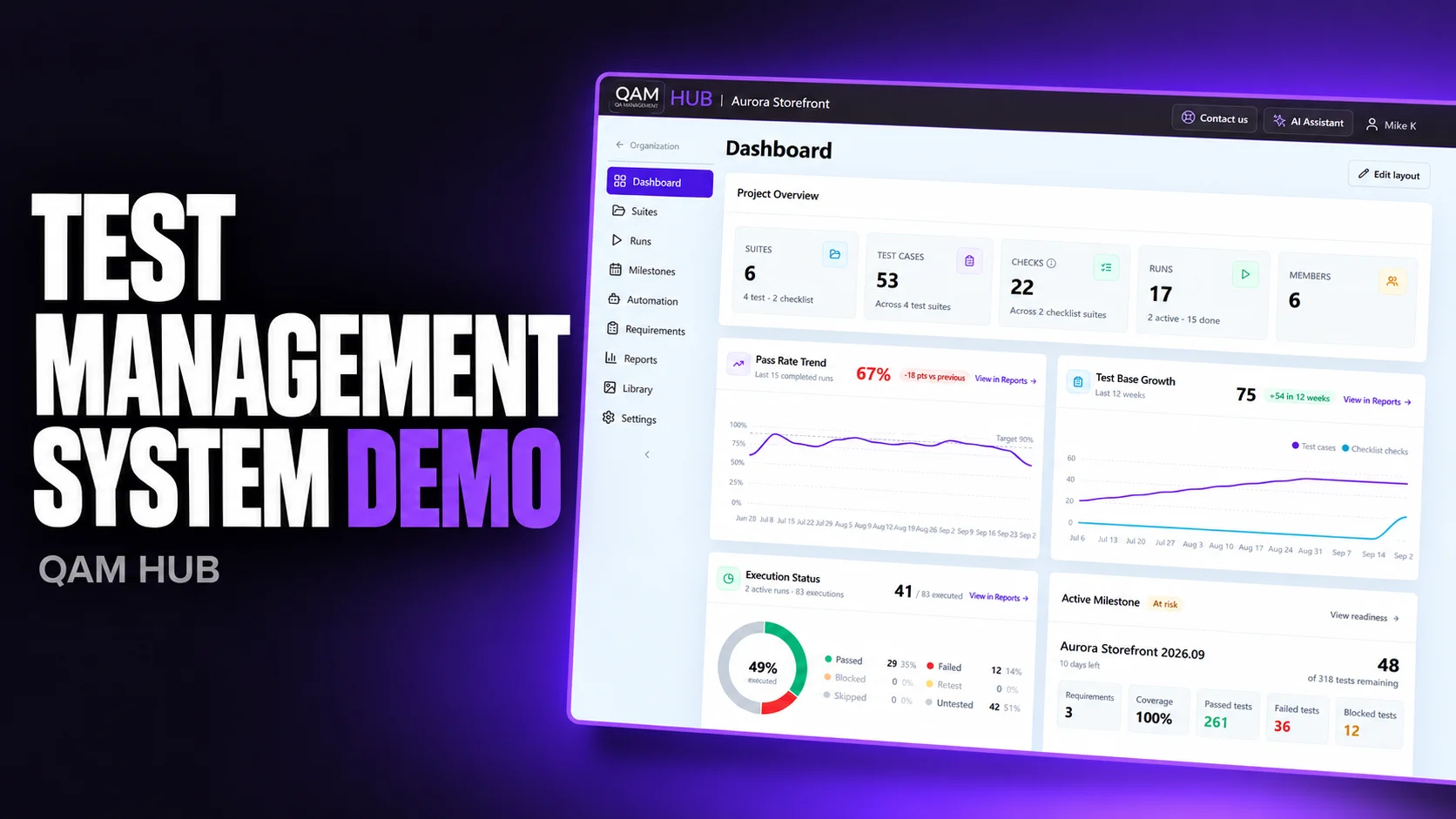
QAM Hub is our AI-first test management system: test cases, runs and Playwright/Cypress results in one place.
Traditional QA is independent - but slow. Developers with AI are fast - but they're marking their own homework. We're the only approach that's both: the speed of AI, with verification by people whose job is to break things.
manual, limited
tests the code
optimized to pass
 https://staging.qamadness.com/services/ai-in-qa/
Trusted by product teams worldwide













We measure success in real outcomes - bugs caught, velocity increased, clients satisfied.
Join 500+ product teams who trust QA Madness with their software quality
Start a ProjectNo surprises. Clear milestones. Full transparency at every stage - from kick-off to final report.
We work with the tools your team already uses - or recommend the best fit for your stack.
Deep vertical expertise means faster onboarding, smarter test cases, and risks caught earlier.
Security-first testing for payment systems, trading platforms, and digital banking with regulatory compliance focus.
HIPAA-compliant testing for patient portals, diagnostic tools, telemedicine apps, and healthcare data systems.
End-to-end testing of checkout flows, inventory systems, PIM integrations, and Black Friday load scenarios.
Functional, performance, and compatibility testing for mobile games, web platforms, and streaming services.
API contract testing, multi-tenant testing, subscription flow validation, and continuous regression for SaaS products.
Testing tracking systems, route optimization algorithms, warehouse management, and carrier integrations.
A growing fintech startup needed thorough testing
before their Series A-funded product launch. Our team embedded with their engineering team for 8 weeks, running 1,200+ test cases across web and mobile.
A high-traffic e-commerce platform had a 2-week
manual regression cycle that blocked every release. We built a Playwright automation suite covering 400+ test cases that runs in under 20 minutes.
A US-based telemedicine startup needed HIPAA
compliance certification for their patient data platform. Our security + QA team delivered a full audit, penetration test, and regression suite.
Implementing software testing as a service includes 5 steps: planning, design, implementation, stabilization, and delivery. Every project is unique and calls, if not for a custom approach, then at least for minor adjustments. Nevertheless, understanding what each phase entails will allow you to see how each QA service and testing activity fits into your processes and integrates with your daily working activities.
Our QA experts learn everything about your software and processes during this phase. They communicate closely with your development and/or product teams to get a complete picture of the project’s objectives, requirements, and intricacies. It will allow for aligning the testing strategy with your business goals.
The QA engineers identify key testing milestones, define the scope of testing, and sometimes suggest other points for improvement beyond testing. A collaborative approach to planning ensures more effective testing and handling of potential quality challenges.
For outsourced software testing services to work and deliver results, all team members must stay on the same page. It is possible only with proper documentation in place. During the design phase, our QA engineers prepare a detailed test plan. It outlines the overall strategy, approaches to risk management, and other essential details. Test cases or checklists are also prepared at this stage.
Our QA team prepares the testing artifacts relying on your project documentation and/or design files. We ensure the ultimate coverage per time and resources allocated for testing the specific product or stage of its development. It involves evaluating software functionality, compatibility, accessibility, and, if requested, performance and security.
Change-related testing makes up a significant part of this phase. QA engineers retest software after bug-fixing and verify it has started working as expected. They also run smoke and regression testing to ensure the core and business-critical functionality functions appropriately after code changes.
QA engineers also pay attention to the system’s stability, performance, and usability. They look for ways to fine-tune the software, making it resilient and capable of delivering consistent performance under various conditions. Altogether, it becomes the groundwork for a successful product launch.
It is necessary to conduct a final round of assessments to confirm that the software meets all quality benchmarks and aligns perfectly with your project objectives. QA engineers run acceptance testing to analyze a product’s readiness based on the specific acceptance criteria.
As a result of proactive cooperation with a QA software testing company, you now have a product poised for a seamless and successful launch. The QA engineers stay tuned during the deployment process, too. They need to ensure the software remains free of critical defects on production and help you minimize any possible disruptions.
Practical guides, case studies, and deep dives on modern software testing.
 Strategy
A single critical bug in production costs on average 100× more to fix than one caught in development. Here is how to calculate your risk exposure.
Read article Automation
We have run both on 50+ projects. Here is our honest take on speed, DX, community, and when to choose each – with real benchmark numbers.
Read article Case Study
From 14-day manual regression to 6-hour automated suite: a step-by-step breakdown of our approach, tools, and results.
Read articleWith QA Madness, you can be certain to get clear communication and transparent cooperation. You can learn more details about the practical aspects of this partnership during an introductory call with our team representative.
No. Most engagements deliver value within the first week - a prioritised test plan and the first round of findings - while deeper coverage builds in parallel.
You do. Every test case, automation script, and framework we build is yours, handed over with documentation so your team can run and extend it.
Not when scoped right. We automate the stable, high-value paths first and keep the suite maintainable, so it pays back in saved regression time quickly.
Absolutely. We don't build in silos. We work directly in your repository (Git/Bitbucket) and integrate with your existing tools (Jira, Slack, Jenkins, Azure), ensuring total transparency.
We plan for it from day one - clean documentation, knowledge-transfer sessions, and maintainable code mean your team can take over whenever you choose.